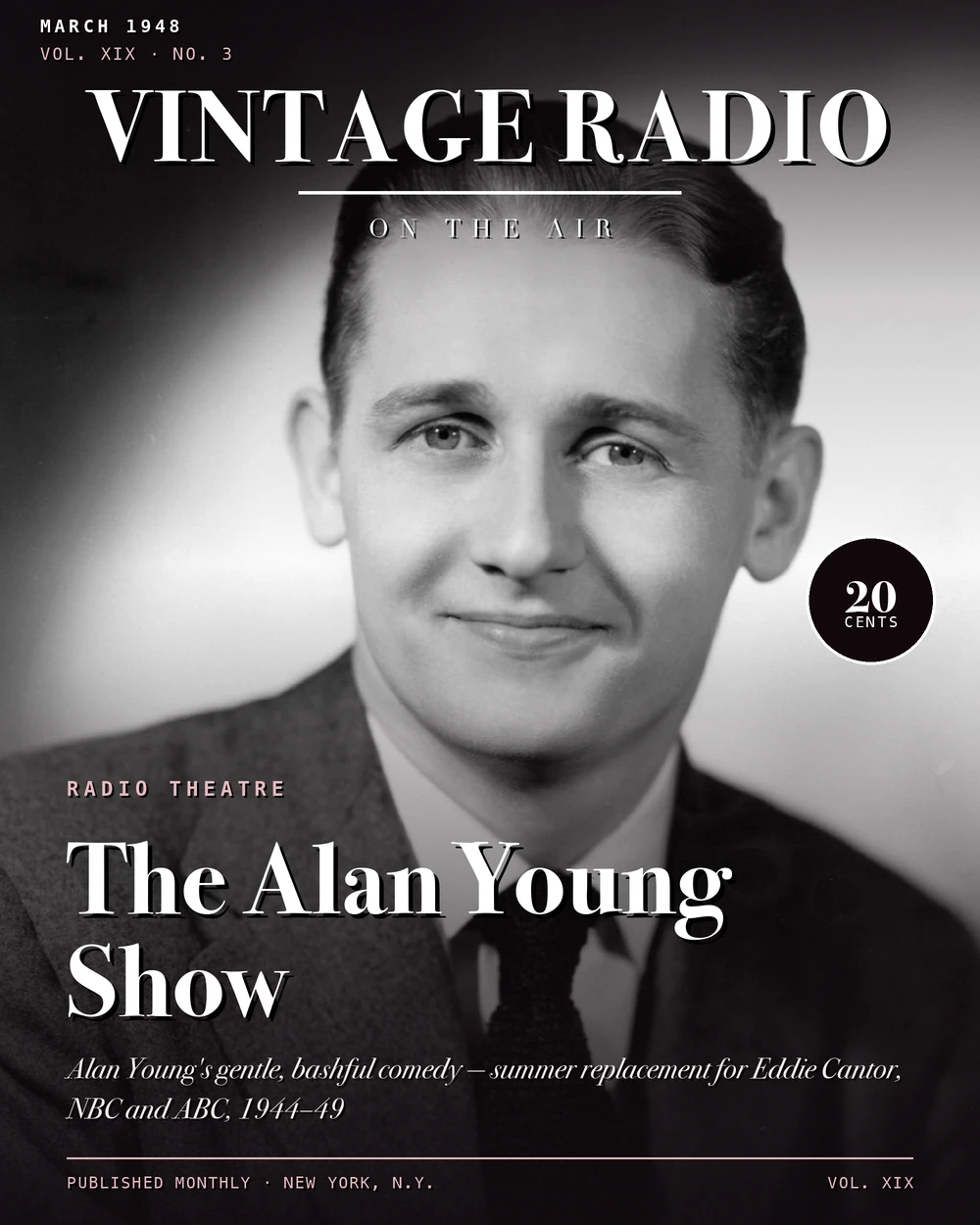
The Alan Young Show
The Bashful Young Man Who Made It Work
Alan Young built a career out of playing a version of himself — a shy, mild-mannered young man perpetually out of his depth. What made that character work was that it wasn't an act. His wife, Ginni, confirmed it plainly: he really was bashful. There's something that comes through in a performance when the actor isn't stretching to reach the part, and Young's particular brand of diffident, put-upon comedy had that kind of genuine quality to it. One trade journal, reviewing his early summer work as a substitute for Eddie Cantor, called it "routine situation comedy" laced with "rapid-fire gags" — a backhanded description that nonetheless captures what was actually on offer. Newsweek went further, describing Young as a "meek, washed-down blond with saucer eyes and a perpetual woebegone manner ... [with] flashes of Harold Lloyd and Charlie Chaplin." That's a real description of a real comedic type, and it stuck with Young through most of his radio career.
The show premiered on June 28, 1944 on NBC — a Wednesday night half-hour at 9 o'clock — as a summer fill-in for Cantor, sponsored by Sal Hepatica. Vocalist Bea Wain and bandleader Peter Van Steeden rounded out the package. It ran only through September 20, but it did enough to earn Young his own franchise, and the story of the next five years is really the story of a performer who kept almost breaking through.
How He Got There
Young was born Angus Young in North Shields, Northumberland, on November 19, 1919 — Scottish parents, a coal-mining tap-dancer father, a singer mother. The family moved to Edinburgh when he was a toddler and then to West Vancouver when he was about six. He fell in love with radio as a sickly child, bedridden with severe asthma, and by thirteen he was already a working radio performer; by seventeen he was writing and performing his own show for the Canadian Broadcasting Corporation. He legally changed his first name to Alan at twenty because Americans kept hearing "Agnes" when he said Angus.
He worked at CJOR in Vancouver, where he became friends with Fletcher Markle, who would go on to a prominent place in American radio. Young's earliest Canadian vehicle was a program called Stag Party, where he was essentially the entire act — writing, performing, carrying the whole thing. When he asked for a raise from his $15-a-week salary at CJOR, the station fired him. He landed on his feet at CBL, where he was soon earning $150 a week doing situation comedy. An agent caught his work there and helped him make the jump to American broadcasting, with his first U.S. appearances coming on the Philco Radio Hall of Fame.
That trajectory — scrappy Canadian origins, a sharp agent, a lucky summer slot — is how a lot of radio careers started. But Young had something that got him past the first audition. His timing was precise and his persona was distinct. He wasn't working in the big-voiced, wisecracking style of many American comedians. He was quieter, more put-upon, more invested in character than in the mechanics of the joke. That made him stand out, and it made one season as a summer substitute turn into five years of his own program.
The Cast Across the Runs
The Alan Young Show moved around quite a bit. After the initial NBC summer run, it shifted to ABC, where it aired from October 3, 1944 through June 28, 1946, sponsored by Ipana toothpaste. On ABC, the show took on more of a domestic situation comedy shape. Jean Gillespie played Young's girlfriend Betty, with Doris Singleton also taking on the role at different points. Ed Begley — who would later win an Academy Award for Sweet Bird of Youth — played Papa Dittenfeffer, Betty's crusty father, a character type that was practically a requirement in radio situation comedies of the period. Writers Jay Sommers and Will Glickman handled the scripts.
The show returned to NBC for the 1946–1947 season, still with Ipana as sponsor, airing Friday nights. Then, after a gap, it came back again from January 11 to July 5, 1949 on NBC, this time sponsored by Tums and airing Tuesdays at 8:30. That final run had a noticeably stronger supporting cast. Jim Backus played snooty playboy Hubert Updike III — a comically wealthy snob who claimed his family had landed at "Cadillac Rock" and threatened to wash an adversary's mouth out with domestic champagne. The character was sharpened by a young writer named Sherwood Schwartz, who would go on to create Gilligan's Island; Thurston Howell III is a direct descendant of Hubert Updike. By 1947 the Dunkirk Evening Observer could note that Backus was "probably best known as Hubert Updyke of The Alan Young Show than he is as Jim Backus."
Louise Erickson played Betty in the 1949 run. The announcer was Don Wilson, the vocal group was The Regalaires (Sue Allen, Fay Reiter, Ginny Reese, and Ginni Young — Alan's wife among them), and music came from George Wylie. The producer-director for that final run was Helen Mack. Supporting cast included Nicodemus Stewart, Hal March, and Ken Christy.
The Hot-and-Cold Career
Young had what could fairly be called a hot-and-cold career in radio — consistently regarded as someone about to make it big, without quite getting there in the way his talent seemed to promise. He made some films during this period, but they got mixed notices. He was signed to The Jimmy Durante Show in 1948, and when his new Tums-sponsored series launched in early 1949, he was still a regular on Durante's program. For a stretch in 1948 and into 1949, he was appearing on both simultaneously. That's not a small thing — it speaks to how much demand there was for him, even if the big solo breakthrough stayed elusive.
The show ended on July 5, 1949, and Young toured the U.S. comedy circuit for a stretch, reportedly hauling his bagpipes along with his jokes. He moved toward television with the same deliberate step he'd taken through radio. He had no shortage of work, but the career arc has the slightly frustrating shape of a performer who was clearly good enough and popular enough to keep getting hired, but who never had one defining moment that put him over in the way that, say, Jack Benny or Bob Hope did.
What Came After
Young wrote a television pilot for CBS in 1950, and the result — also called The Alan Young Show — debuted that April as a live variety sketch-comedy program. It won the 1951 Primetime Emmy for Outstanding Variety Series, and Young took home the Best Actor Emmy the same year, topping José Ferrer in what was then a single undivided performance category that lumped variety performers and dramatic actors together. TV Guide dubbed him "the Charlie Chaplin of television." The show ran in its original variety form until early 1952, then came back in 1953 as a more conventional sitcom with Young as a bank teller before ending that June.
The name Alan Young, for most people today, connects to a different television show entirely. He played Wilbur Post in the CBS-TV series Mr. Ed from 1961 to 1965 — the gentle, hapless man who happened to own a talking horse, and the only one the horse would talk to. The same qualities that made his radio character work translated directly. Later he became Disney's voice of Scrooge McDuck for more than forty years, beginning with a 1974 Disneyland Records Christmas Carol adaptation and continuing through Mickey's Christmas Carol, DuckTales, and a long string of projects until his death in 2016 at ninety-six.
The radio work that preceded all of it showed those qualities being developed and refined across multiple networks, multiple sponsors, and multiple casts. The show never had one definitive configuration; it kept shifting and adjusting, finding new characters and new timeslots. What stayed constant was Young himself, playing some version of that bashful young man his wife confirmed was real.